
The difference between IMS, WMS, ERP, BI, and Inact
Do you actually understand the difference between ERP, BI, IMS, WMS, and Inact?
It can be difficult to navigate the different system types in the supply chain landscape.
And most companies lack a clear understanding of exactly where the best investment lies.
You already have an ERP system. Perhaps also an IMS, WMS, and BI dashboards.
Data is pulled from the ERP.
Inventory data is fetched from the IMS.
BI displays a dashboard.
And in the end, it's all compiled manually in Excel.
The systems have the data.
But they don't necessarily give you the answer.
And that's precisely where many companies are left without the most important thing:
Insight into where value is created – and where it disappears.
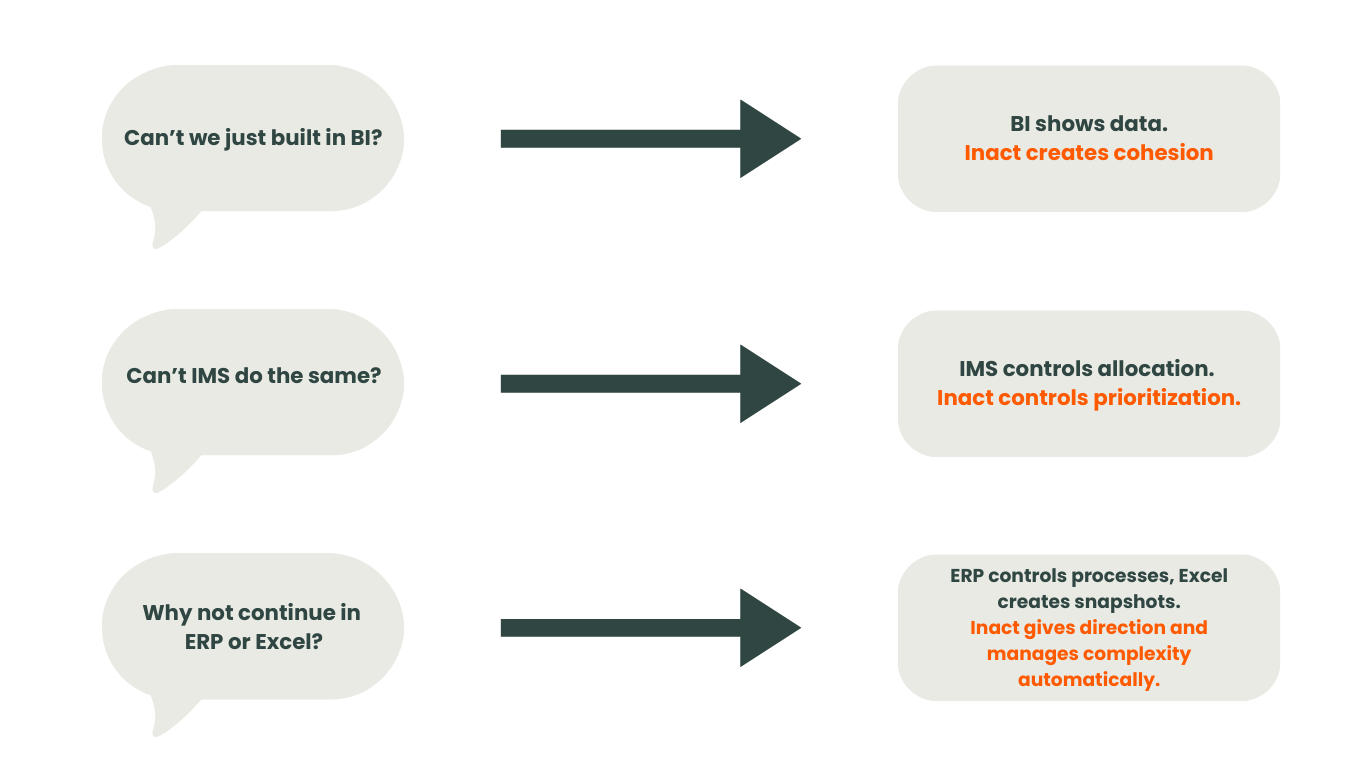
Why does the confusion arise?
You're probably thinking: "That sounds like our BI setup." Or maybe: "Our IMS can do that too."
But it is not that simple.
Because even though many of the systems overlap, they solve entirely different problems and create vastly different types of value:
-
An ERP is built for management and control.
-
An IMS is built for planning.
-
BI is built for visualization.
None of them are built to prioritize commercially.
View your tech stack as a body
A simple way to understand the differences is to imagine your tech stack as a body:
- ERP is the backbone, which ensures a stable foundation, but reacts slowly and only tells you what has happened.
- WMS is the muscles, which perform the heavy work (picking, packing, moving) and optimize movement (in the warehouse). Although it is strong, it does not know why it is moving things - only how.
- BI is the eyes. It provides a clear view (of your data) through visualizations and reports, but can only see what has already happened - not what you should do next.
- IMS is the bloodstream. It is a huge organ that ensures that the necessary resources are present and circulate so that the whole body can function. It ensures flow, but is reactive and cannot plan for the future.
This is where Inact differentiates itself:
We're the brain.
We analyze, prioritize, and tell the rest of the body what creates the most value.
Inact doesn't replace - we connect
Where others focus on what is happening, Inact helps you understand why it matters - and what creates the most value for the company.
Inact Now makes a difference in three ways:
- Inact creates coherence: Inact creates an overarching direction that connects all parts of the business.
- Inact creates prioritization: IMS/WMS/ERP/BI tells you what is happening - Inact tells you what matters.
- Inact makes BI stronger: Inact defines commercial rules, BI summarizes and visualizes.
What's your next step?
The next step doesn't depend on your systems but on your maturity and your ambitions.
Perhaps you recognize yourself in one of the following situations:
- You have a lot of data, but struggle to identify value. Perhaps you have high tied-up capital.
- You have high inventory levels, but no universally applicable explanation. Perhaps you have a large safety stock.
- You want to elevate decisions from operational optimization to commercial prioritization. For example, through category management.
- You lack a unified language between finance, sales, and the supply chain.
If you can recognize yourself in any of these, then Inact may be the next step. Or perhaps your next step is something else.
To make it easier, we have developed a guide that helps you choose the right solution for your maturity, ambitions, and needs - regardless of whether the next step is ERP, BI, IMS, WMS, or Inact.
Then we can help you make the best decision - regardless of the solution.
Download the guide below:
Join a growing network of supply chain professionals working smarter with data.
Access free insights, cases, and frameworks to help you drive better decisions.