Your supply chain is the path to profitable growth. The goal is significantly lower inventory levels, high service levels toward customers, and agility in response to market changes. We give you the 5 fail-safe steps to a highly optimized supply chain. All you need to do is read along.
In the highly optimized supply chain, the business works closely across silos, and with suppliers and customers. Based on 150+ implementations, we have developed a 5-step model that outlines and explains the different maturity stages a company goes through on its way to a highly optimized supply chain.
Our experience shows that most companies get stuck at step 2, product profitability & supplier collaboration, as they lack the willingness and tools to move forward.
The 5 supply chain development stages toward maturity
The 5 steps in the model describe the company’s strategic and operational maturity across the classic silos: sales, procurement, and logistics. Steps 1–3 primarily look backward in the chain, whereas steps 4–5 also involve customers and higher complexity.
– You can respond quickly to market changes if there is transparency in your supply chain.
Step 1: Silo thinking & lack of facts
Companies at step 1 focus on top-line growth and supply security. They operate under the assumption that all products and customers are equally important, and out-of-stock situations create major disruptions.
As a result, they operate with unnecessarily high inventory levels and low inventory turnover.
Decisions are more often based on gut feeling than data. The company’s data is not used strategically, and both management and employees operate without a shared decision-making foundation.
Silo thinking is widespread: sales, procurement, and logistics operate independently and try to optimize their own KPIs.
Management and employees are not aware that the silos are working against each other, thereby limiting the company’s potential for success. At this stage, the organization lacks a shared language and an understanding that change is necessary.
Step 2: Product profitability & supplier collaboration
The jump from step 1 to step 2 happens when the company realizes that growth is not necessarily profitable. They also recognize the need to serve the market in a differentiated way — some products are more important than others, and some customers matter more than others. At this stage, the company starts working with its data and uses new insights to create a shared language across departments.
At step 2, the primary focus is on analyzing product profitability.
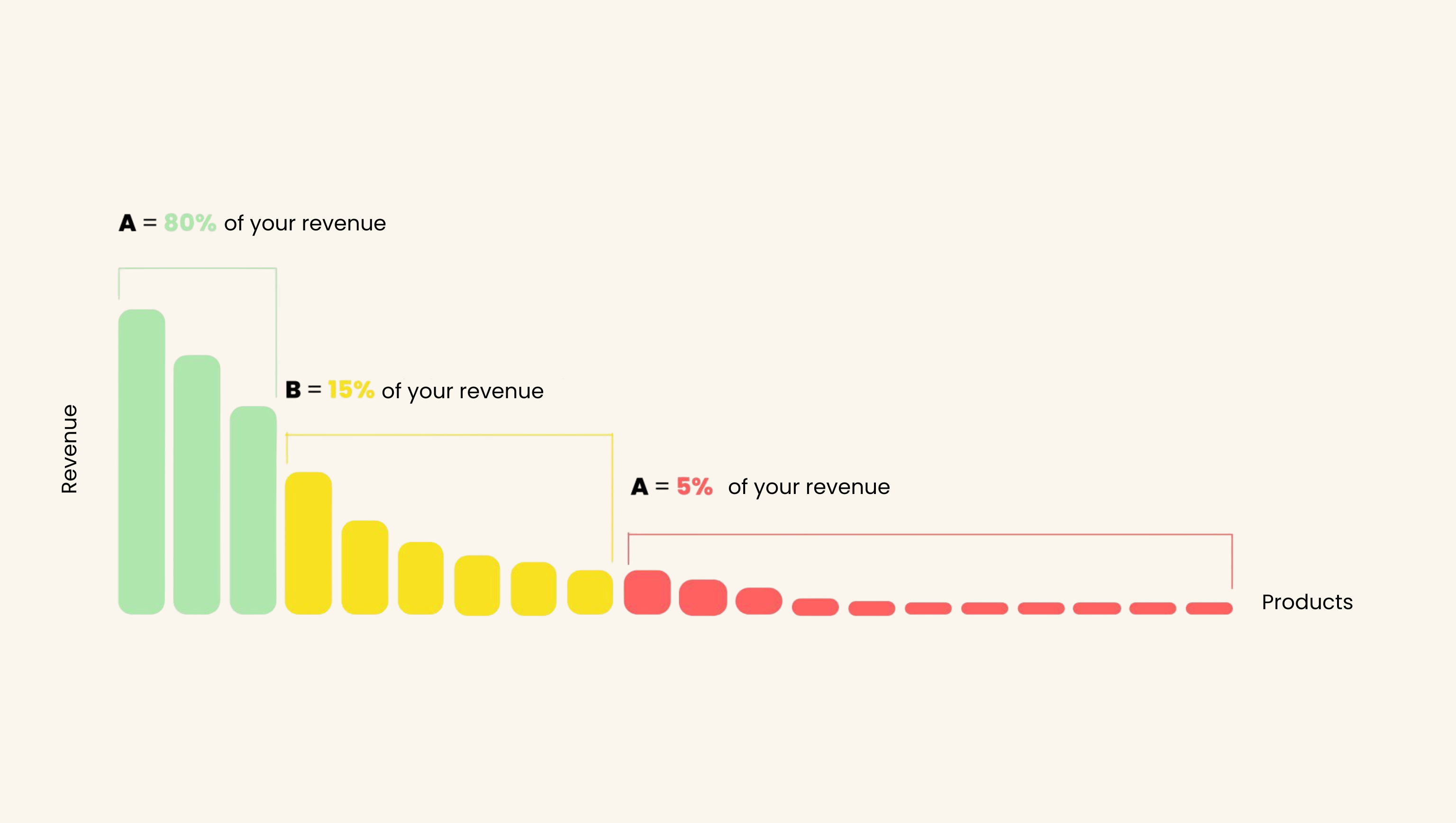
The company realizes that only 20% of products generate 80% of revenue — and begins shaping its processes accordingly.
At this stage, companies begin working systematically with analysis and identify their most important products (AA) and less important ones.
Also read: ABC-categorization: How to gain an overview
With management support, a strategic decision-making foundation and shared language are established, enabling procurement and logistics to make decisions in the company’s best interest. This is followed by a “cleanup” of the existing supply chain:
- Products that primarily contribute noise and complexity are removed from the assortment.
- The company defines rules that ensure a healthy balance in inventory, balancing supply security and inventory levels.
Supplier collaboration becomes structured
At step 2, collaboration and negotiation with suppliers are based on a differentiated approach(AA items are more important than CC items). The goal is for terms and delivery conditions to reflect the company’s own priorities.
Small adjustments in major supplier contracts can be seen directly on the bottom line.
Step 3: Sales & Supply Chain
At step 3, the company builds a bridge between sales and supply chain, creating a shared agenda.
It is a significant task to align these two worlds — the commercial and the operational — which are traditionally driven by very different goals and profiles.
This phase is largely about people, shared priorities (the ABC language), and change management.
Secondarily, it's about analysis. However, facts are required to create a shared understanding of reality, followed by planning and systematizing routines and processes that ensure the supply chain is — as much as possible — ahead of demand and customer behavior.
Companies before this stage are often reactive and lagging behind demand.
The purpose of the cross-functional S&OP process is to connect those who know customers best (sales) with those responsible for delivery (supply chain).
Step 4: Customer profitability
At step 4, the company is ready to analyze customers and their profitability.
Many companies serve customers who are actually unprofitable — they just don’t know it. With a solid data foundation that clearly shows profitability, the company gains a strong basis for prioritizing customers and renegotiating contracts.
The journey toward a highly optimized supply chain
Step 5: The highly optimized supply chain
In the highly optimized supply chain, all units work closely together across internal silos and with both suppliers and customers. The goal is to deliver outstanding service in a profitable and responsible way.
At step 5, negotiations with both suppliers and customers are based on mutual interest in strengthening each other’s business.
Strengths are amplified, and weaknesses are reduced across the “extended supply chain,” which includes both customers and suppliers.
This closeness creates a healthy business with stable delivery performance.
Parallel supply chains within your business
At step 5, the company begins working with supply chain segmentation — effectively creating multiple supply chains with different service levels. Not all customers require the same level of service or attention.
- Some customers prefer stable deliveries of standardized orders once a month.
- Others require more frequent deliveries, customized packaging, and delivery to multiple locations.
Join a growing network of supply chain professionals working smarter with data.
Access free insights, cases, and frameworks to help you drive better decisions.