
Purchasing as a Strategic Driver of your Company’s Value Creation
Purchasing is often overlooked when it comes to value creation in your organization. Historically, the function has been viewed as an operational support function focused on ordering goods and cutting costs, while few have realized that purchasing also influences the company’s valuation.
Supply chain leaders’ general reaction to market uncertainty has long been a unilateral focus on cost reduction: savings, efficiencies, and lower unit costs. It may seem logical, but in a world marked by volatility, complexity, and uncertainty, it is rarely sufficient.
The problem isn’t that companies focus on efficiency—it's that they rarely link purchasing decisions to the company’s overall value creation.
And if the goal is to build a robust, valuable, and long-term business, it’s necessary to challenge this understanding.
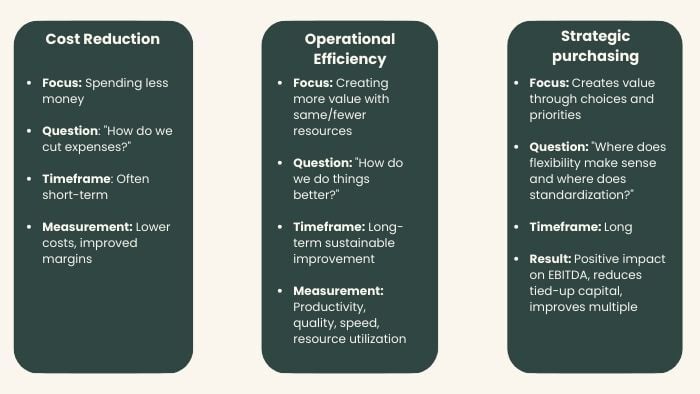
Value in supply chain
In your company’s complex reality, it’s not only the cost level that determines your value, but the quality of earnings and the ability to repeat it.
The company’s value (EV) can be comprehensibly described by the formula:
EV = EBITDA × multiple – NIBD
In practice, the formula raises three central questions:
- EBITDA: How good is the business at generating earnings?
- Multiple: How much trust does the market have that earnings are stable and repeatable?
- NIBD: How much capital is tied up—and how vulnerable is the business?
As such, value is about more than how much you earn. It’s equally about how earnings are created—and how controllable they are.
Everything that affects EBITDA, therefore, directly or indirectly affects the company’s value.
And this is where purchasing can make a difference.
When cost cutting isn’t enough
Cost reduction can strengthen EBITDA in the short term, but if the focus stops there, there are consequences.
Purchasing is not just about price, but also about availability, predictability, tied-up capital, quality, delivery reliability, and other factors that influence the market’s trust in your company.
When cost reduction becomes the primary goal, we often see side effects such as:
-
Increased complexity to achieve marginal savings
-
Lower flexibility and higher risk
-
Increasing tied-up capital in the form of safety stock
-
Decisions that optimize locally but harm the whole
The point isn’t that cost reduction is wrong, but that it is insufficient if it does not support a clear strategic direction.
The strategic level: Purchasing’s influence on EBITDA
Imagine your company as a store with a really smart purchaser. The smart purchaser knows that shelf space is limited, capital is limited, and attention is limited.
The task, therefore, is not to have the most products, but the right products.
When purchasing has a clear direction for which products create real value, you can influence EBITDA through:
- Gross margin: Better prices, supplier selection, and lower total cost of ownership
- Revenue: The right products, in the right quantities, at the right time
- Inventory: Lower capital binding without compromising service
- Creditors: Better payment terms and improved liquidity
Suddenly purchasing doesn’t just create savings—it now works strategically, frees up capital, enables growth, and lifts the company’s market value.
Of course, purchasing doesn’t create this effect alone, but acts as a central pivot between sales, operations, and finance, where strategic choices are translated into concrete earnings and capital release.This cross-functional collaboration across your business is essential.
A common understanding of the business
Purchasing affects earnings, capital binding, and risk every single day. Yet many organizations struggle to build a shared understanding of where and how that value arises—it requires insight, data, and a common language across the organization.
A common language in practice means that purchasing, finance, and management see the same connections between customers, products, earnings, and capital—and can discuss the consequences of decisions based on the same data.
When the connections between customers, products, suppliers, and finances become visible, the dynamic changes. Decisions move from gut feelings and isolated KPIs to holistic choices that management can understand, prioritize, and guide accordingly.
Suddenly, the conversation changes focus:
-
Which suppliers are critical for our differentiation?
-
Where does flexibility make sense—and where does standardization make sense?
-
Which products tie up capital without generating stable earnings?
-
Where do we accept risk and where do we not?
This is where purchasing moves from being a reactive function to one that shapes the business.
When strategy and efficiency meet
The purchaser contributes to the organization’s value creation on several levels:
-
Strategic insight – Where do we create value?
-
Choices and priorities – Customers, products, service.
-
Operational execution – Efficiency where it makes sense.
But the real strength only emerges when all levels are connected.
Because when purchasing works strategically and can document the link between decisions, earnings, and capital, the function moves from being an operational support to becoming a central driver of the company’s value creation.
Ultimately, it’s not just about optimizing EBITDA in the next quarter, but about building a business where earnings can be repeated—and where value can be explained, managed, and grown over time.
Successful companies, therefore, are not the ones best at squeezing prices, but those that understand how to manage purchasing as a strategic discipline.
Discover how Inact can create coherence in your company or sign up below to find out what next step is right for your business.
Join a growing network of supply chain professionals working smarter with data.
Access free insights, cases, and frameworks to help you drive better decisions.