

Global supply chains are subject to increasing volatility. This means that organizational transparency, flexibility, and resilience are no longer just "best practice" — they are critical competitive parameters.
End-to-end visibility is therefore no longer "nice-to-have," but a prerequisite for navigating uncertainty.
Nonetheless, a study by Bain & Company shows that almost 80% of companies assess that their procurement is not mature enough to meet their business goals.
That's why we, in this blog, take a high-level look at supply chain maturity and what it takes to create scalable, profitable growth in a complex world.
Why do mature organizations perform better?
PwC describes that companies with mature supply chain processes earn on average 30% more EBIT than companies with low maturity.
These companies are:
-
More customer-focused
-
More flexible
-
Better at prioritizing
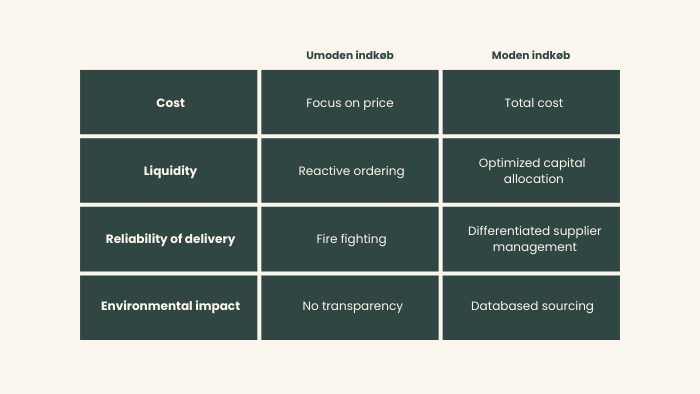
We actually see that mature organizations perform better across multiple dimensions:
-
Costs: lower structural costs
-
Liquidity: lower tied up capital and better cash flow
-
Delivery reliability: high delivery certainty without over-investment
-
Environmental impact: better decisions about transport, inventory, and assortment.
But what exactly is maturity?
In practice, maturity is the ability to make conscious decisions across functions — before consequences hit the bottom line.
It's the difference between reacting to problems and preventing them.
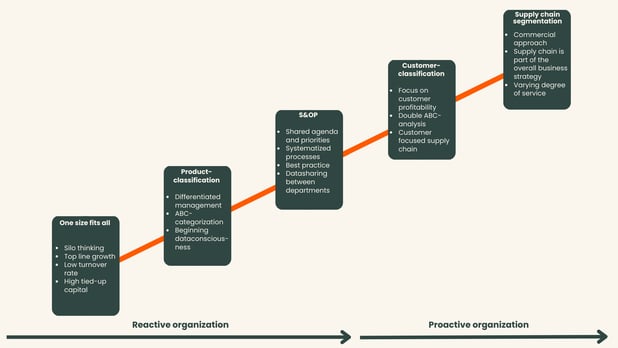
Maturity is a staircase, not an elevator
Since maturity ultimately concerns the entire organization, it must be built step by step.
Anders describes 5 foolproof steps to a optimized supply chain here.
It's not about more data, but about creating a shared decision-making foundation from the data you already have. Such a process can be described across four levels:
-
Reactive: Fire-fighting and silos
-
Stabilizing: Local optimizations and the beginning of breaking down data silos
-
Coordinated: Shared prioritization and best-practice structures
-
Proactive: A shared strategic direction that enables decisions to be made before problems arise
This is where you move from reactive to proactive on the maturity staircase.
Procurement: The overlooked maturity factor
As described in another blog, procurement is the bridge between the operational and the commercial. That's why procurement is also important to highlight when it comes to organizational maturity.
Procurement is, after all, where connection is either created — or broken.
Immature procurement is typically:
-
Price-focused
-
Reactive
-
Supplier-oriented
-
Measured on savings rather than value
A mature procurement, on the other hand, is:
-
Data-driven
-
Segmented
-
Strategically prioritizing
-
Integrated into commercial decisions
Maturity therefore requires a shared data foundation where procurement, sales, and inventory see the same reality.
This is where end-to-end intelligence becomes critical.
End-to-end overview: Your radar in an uncertain world
End-to-end visibility means you see the connection between :
-
Supplier lead time
-
Inventory coverage
-
The promises the sales team has made to customers
More importantly:
It means you can see the consequences of a decision before it is made, and prioritize according to what you have collectively decided matters most.
End-to-end intelligence is therefore not just an overview tool — it is a decision compass.
This matters because it isn't the fastest company that wins in volatile markets.
It's the company that understands the connection between decision and consequence across the entire value chain.
So the question is not whether you have data.
The question is:
Are sales, procurement, and supply chain working from the same reality?
Maturity as a competitive advantage
Maturity is not about implementing a new system.
It's about creating coherence between the decisions that are already being made every day, so you can make decisions with full understanding of their consequences.
In volatile markets, it's not the most digitalized company that is strongest.
It's the company that understands the connection between costs, earnings, service, and risk — and prioritizes accordingly.
Therefore, in a world characterized by uncertainty, the question is no longer:
"Can we afford to invest in maturity?"
But:
"Can we afford not to?"
Spoiler: You can't.
In the next blog we take a closer look at a more concrete question:
Is your supply chain mature enough for the growth you want?
Until then, you can also read more about our end-to-end intelligence solution here.
← Back to the inspiration page