
How to tell if procurement is a support function - or a growth engine

3 min read
19. January 2026

Back to the inspiration page

Do you find it difficult to turn your insights into concrete action proposals when meeting with management?

You know your inventory holds great value, but you lack the language and data to support your intuition. 

If so, you’re not alone.

Several of our clients have been in the same situation. At Elcor, Kenneth experienced how skepticism between departments created internal friction. And at Alfa Laval, meetings between sales, procurement, and finance often turned into a wrestling match over inventory value and safety stock.  

This isn’t a collaboration problem or a lack of commitment.

It’s a sign that the supply chain is still perceived as a support function – not a growth engine.
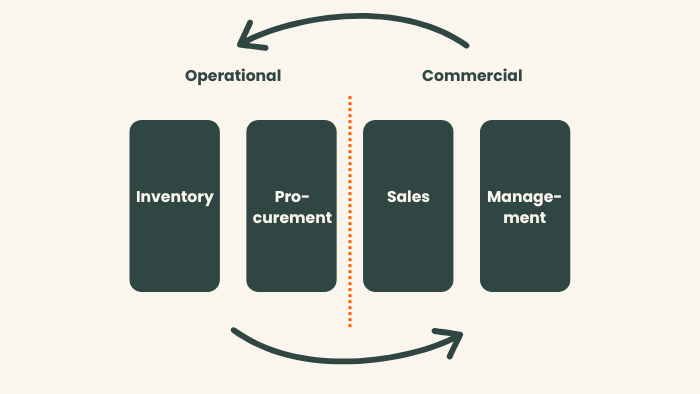
 

When supply chain is solely operational

When procurement and inventory are mainly involved to deliver numbers and savings, the organization lacks a common language that connects operational execution with commercial goals.

This typically shows when procurement:

  • Responds to needs instead of shaping decisions

  • Optimizes isolated costs

  • Operates reactively instead of proactively

  • Only speaks operationally

When purchasing is purely operational, it becomes a support function.

And a support function cannot manage the complexity that a growth strategy inevitably creates.

The more the company grows, the more products, customers, and suppliers must be prioritized—and the greater the need for cross-functional decisions.


Complexity is not the villain

A recurring challenge among all our clients is the lack of overview. Broadly speaking, this lack of overview concerns the organization’s complexity, but on a practical level, it stems from a lack of internal coherence.

If the whole organization doesn’t work together, more products, more customers, and more suppliers only create more complexity — not healthy growth.

This is what we call a wicked problem.

But complexity itself isn’t dangerous.

Lack of holistic thinking is.


Procurement as the bridge between operations and commerce

When purchasing acts as a support function, inventory and procurement are on one side, and sales and management on the other. In between lie the decisions that require coherence.

It’s here—when decisions are based on gut feelings and guesswork—that friction and misunderstandings arise, precisely because departments operate in silos.

But when the supply chain becomes customer-facing, it connects both sides and turns into a growth engine for the company.

Lasses tegning Engelsk

The Silo Problem: When Everyone Is Right – and still wrong

When procurement is merely a support function, each department works from its own perspective.

There is no shared strategic direction — only local optimizations.

And that’s where value disappears between departments.

Meetings often look like this:

  • Sales wants a broader product range and higher service levels
  • Procurement wants fewer suppliers
  • Inventory wants to reduce capital binding
  • Management wants growth

Everyone is right.

But no one has an overview.

And without an overview, decisions end up as either compromises or conflicts.


The Shared Strategy – A Customer-focused Supply Chain

The solution isn’t more meetings, more KPIs, or more reports.

The solution is a customer-driven supply chain where decisions are made across departments, grounded in customers, products, and suppliers.

For example, Alfa Laval, together with Inact, managed to build bridges between departments, factories, and management layers. Today, Inact is an integrated part of the company’s Sales & Operations Planning (S&OP) process.

This is because Inact Now creates shared insights across the organization, breaking down silos so decisions can be made from an end-to-end perspective.

Results of the improved performance include:

  • Greater awareness and a shared language

  • Better delivery performance

  • Reduced capital binding

  • Clear inventory policies

All of these clearly demonstrate procurement’s impact on growth.

Because when the supply chain becomes customer-driven, procurement stops being a support function — and becomes a strategic business partner.

What is procurement in your organization?

So, what is procurement in your organization — a support function or a growth engine?

Is your procurement function primarily responsible for:

  • Cost savings

  • Compliance

  • Reactive deliveries

Or does procurement actively contribute to decisions about:

  • Which customers you should grow with

  • Which products you should prioritize

  • Which suppliers create real value

The difference is crucial.

Because the question isn’t whether purchasing can contribute to growth— but whether your organization has given it the opportunity to do so.