

Are you using rearview mirror data to navigate your company?
Rearview mirror data - or historical data - is quite useful…
If the road ahead of you is perfectly straight.
But it rarely is. On the contrary, it is filled with turns, hills, bumps, and blind spots.
This is precisely what reality looks like for many growing SMEs: unpredictable, complex, and often characterized by sudden changes in demand, supplier performance, or inventory levels.
In that landscape, it is not enough to know what happened. You need to be able to predict why, what is coming, and, not least, what you should do about it.
That requires more than reports and spreadsheets.
In this article, we dive into how you create a technology stack that can handle reality - and not just describe it.
We combine two of the most important best practice concepts for modern data-driven companies:
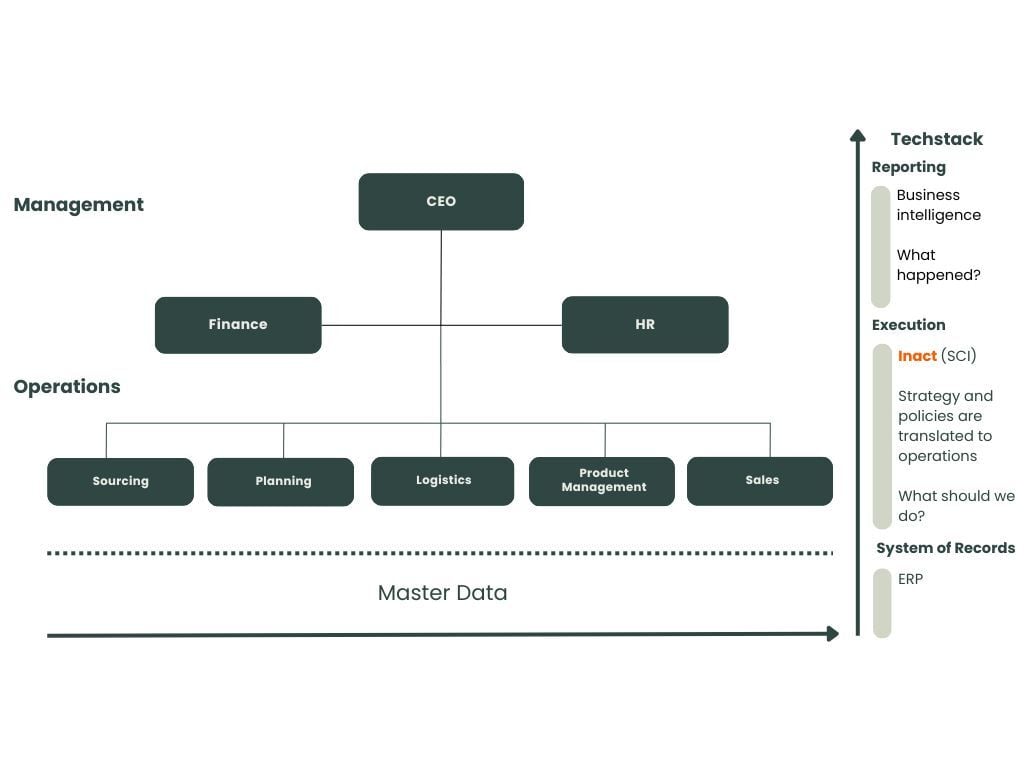
- Pace Layered Architecture – which helps you structure your systems according to their purpose and speed of change
- The four levels of data analysis – from the descriptive to the action-oriented
Together with a platform like Inact, which makes data operational, we show how you can create decision-making power in both purchasing and the supply chain - not just reactively, but proactively.
Pace Layered Architecture – why one system is never enough
This recognized framework divides your systems into three layers:
- System of Record – typically the ERP system. Where data is stable, reliable, and rarely changes.
- System of Differentiation – this includes PIM and SCM tools such as Inact. This is where strategy is translated into operational execution.
- System of Innovation – experiments and agile tools that can test new ideas quickly.
You shouldn't choose just one - you should combine them.
Systems must work together, not fight against each other.
Four levels of analysis: from “what happened?” to “what do we do now?”
There are roughly 4 types of data analyses—and they should be seen as a closed loop where the next level is dependent on the previous one.
Most BI tools already get stuck at the first type of analysis, as it intrinsically involves analyzing historical data.
This is also primarily why BI tools often fail as execution tools.
.jpg?width=1024&height=768&name=Blog%20Forskellen%20p%C3%A5%20IMS%2c%20WMS%2c%20ERP%2c%20BI%2c%20konsulent%20og%20Inact%20(2).jpg)