

On the surface, your company is successful. Revenue is growing, more products are being introduced, capacity is expanding, and more customers are coming on board. You're really busy. So why change anything?
Because growth's secret friend — complexity — is eating up large parts of the company's earnings.
Studies show that complexity can eat up to 40% of a company's earnings. The whale curve illustrates how complexity only adds value up to a certain level, after which the value of complexity will decrease.
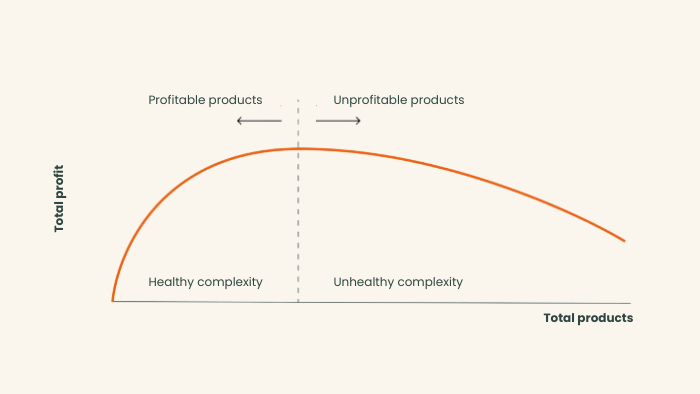
The magic balance point
Companies that handle complexity correctly achieve better competitiveness, increased earnings, and a healthier, more sustainable business.
To manage complexity, it's necessary to understand what it actually means.
Imagine you have 60 items, 2 customers, and 3 suppliers. In that case, it will be relatively easy to understand things like which customers buy which products. And you'll quickly be able to get an overview of how much each individual item contributes to your earnings.
Now imagine you have 1,500 different items, 300 different customers who all have different needs and buying patterns, and 180 suppliers. In that case, your costs for sales, marketing, warehouse handling, administration, etc., will naturally increase. And it will become far more difficult to understand what each individual item actually costs you to stock.
What's worse is that your costs don't increase linearly. They increase exponentially as your company grows larger and complexity increases. In fact, your costs can increase to such a degree that you can experience increased revenue without your earnings keeping pace.
Healthy and unhealthy complexity
Complexity is like weeds. It's easy to create but difficult to keep down. It's the result of the easy way where you simply let things happen without making the difficult decisions. But complexity is also a natural part of growing larger. That's why it's an important management task to identify and distinguish between healthy and unhealthy complexity, and ensure that the organization maintains focus on the most value-creating assets.
Keeping complexity in check is a continuous management discipline, and it requires focus and the ability to say no. It's a difficult and rarely popular discipline, as saying no to pursuing new activities goes against new initiatives, development, and growth. In the long run, however, it will give the organization more breathing room, better returns, and more satisfied customers.
It's remarkable how many companies — despite all reason — choose to keep products and customers that are unprofitable. In most cases, this is due to lack of transparency.
Where is your organisation?
Når det kommer til at gøre en virksomheds udvalg af produkter og kunder 100 % rentable, er virksomheder i et af fire stadier. Hvor passer din virksomhed ind? In regards to making your selection of products and customers a 100% profitable, your organisation is located in one of these four phases:
Phase 1: Complexity costs on the bottom line
The company focuses on growth, but 10-20% of the product and customer portfolio is unprofitable. This affects the bottom line, but the dialogue about a solution remains locked.
Phase 2: Break with the status quo
Management realizes that complexity has reached a critical level. The company is analyzing its selection of products and customers, but the difficult decisions remain unanswered a little longer, as the culture works against them.
Phase 3: Profitable growth
The company has found the formula and is able to distinguish healthy and unhealthy complexity from each other according to the whale curve. Management breaks with "one size fits all" and plants the seed for a new data-driven culture and mindset in the company.
Phase 4: End-to-end transparency
The organization has end-to-end visibility and knows how complexity costs are distributed across customers and products. Proactive behavior ensures that the company is constantly optimized for best performance, both toward customers and the value chain.
Control your complexity
When you need to handle the complexity that has arisen, the right answer is not always to reduce complexity as much as possible, but rather to find the right level of complexity. To be very clear, complexity is not bad in itself — it just needs to be controlled.
Sometimes a bit of complexity can be a good thing. For example, today's customers would probably not be satisfied if they could only choose a gray Volkswagen without being presented with other options. The key to managing complexity lies in reducing the costs of necessary complexity while simultaneously reducing the level of unnecessary complexity.
To get the full effect of complexity reduction, you must work with market-facing and operational perspectives in parallel and iteratively in waves. Complexity reduction is a cross-functional exercise that requires involvement from both the commercial and operational sides to succeed.
4 steps to reduce complexity and accelerate growth
1. Data & Business Analytics
Start by examining how you get your insights. And make sure they're insights you can act on — get 6 tips for executing on your data here.
2. Cost-to-serve
Start monitoring indirect costs related to your products and customers.
3. Correct prioritization in management
Create openness in management to discuss and ensure correct priorities in daily operations.
4. Service level agreement
Set up guidelines that operations can lean on in everyday work when they need to make critical priorities.

At Vikan A/S, they've cracked the code
"We lacked tools that could visualize our data and help us execute in our supply chain."
Lack of data and complexity in Vikan's value chain challenged them. For Production Planner and Buyer René Kälberg, who is the project lead on the Inact Now project, it was clear — the time had come for change.
Today, their procurement, production, and inventory move in the same direction, make decisions based on data, and have paved the way for more satisfied customers, better earnings, and high delivery performance.
Results:
- Maintained their sky-high delivery performance
- Managed to reduce costs
- Ensured better cross-functional collaboration
Read how Vikan maintains satisfied customers and high delivery performance here.
Do you have control over your complexity?
If you want to know more about how we can help you reduce complexity in your business, book a no-obligation demo..
You can also read more about our end-to-end intelligence solution here.
Join a growing network of supply chain professionals working smarter with data.
Access free insights, cases, and frameworks to help you drive better decisions.