Only 8% of your products make a difference.
The theory behind the ABC analysis is built on the idea that some items are more important than others.
Your success is defined by your ability to focus on the few critical items (AA) that make up your core business. This means you should not distribute your time and resources equally across the entire product portfolio.
What are A, B, and C?
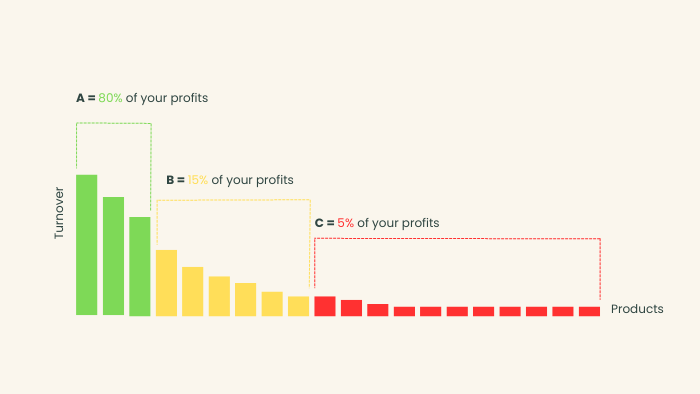
The classic textbook example of an ABC analysis divides items into 3 categories: A, B, and C, based on how well they perform.
- A items are your most important items. The category contains very few, extremely profitable items. On their own, they generate 80% of your revenue.
- B items are slightly less important items. This category accounts for approximately 15% of your revenue.
- C items are your "long tail" items. These items play an insignificant role when we talk about the bottom line, but make up more than half of your item numbers! Together they generate only 5% of your revenue.
Revenue is not the only thing that matters
By dividing items into A, B, and C based on revenue, you get an idea of the significance of the various items.
But in order to develop and implement an intelligent purchasing strategy, you need to know more, including:
How often you sell your items.
Add another "A" to the ABC code
Conduct another ABC analysis on your items, this time based on order picks, so that:
- A items make up 80% of all picks
- B items make up 15% of all picks
- C items make up 5% of all picks
AA items: if an item scores an "A" in revenue and an "A" in picks, it receives the ABC code "AA."
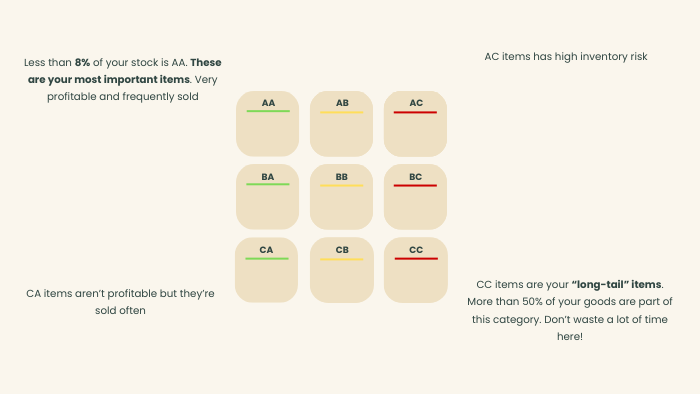
The double ABC matrix
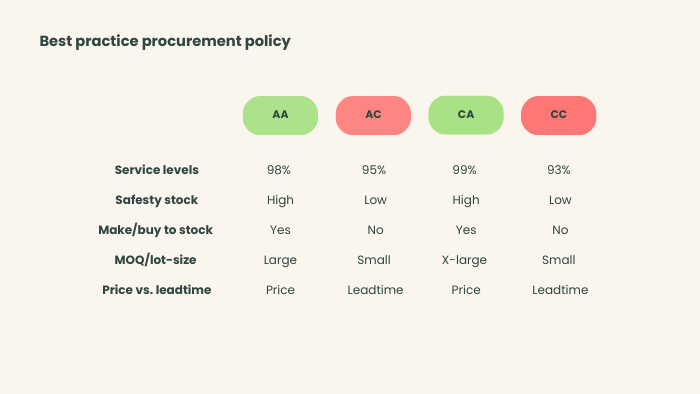
All your items are now divided into 9 ABC categories. Each category contains items that behave "in the same way" and impact your business. Use the 9 categories to adjust your purchasing strategies to match the behavior of the items. For example, you will treat an AA item markedly differently from a CC item when it comes to price negotiation, safety stock, and order sizes.
Characteristics of the 4 different corner categories:
AA: Focus on the 8% that matter
Your AA items make up less than 8% of your product portfolio, but account for 50% of your revenue — and sometimes more!
- Keep a close eye on your AA items — this way you protect your core business.
- Even small price changes will significantly impact your earnings.
- Make sure your buyers understand the importance of these items — it pays off.
Use purchasing policies and purchasing suggestions to ensure correct prioritization
When both you and your colleagues understand the significance of A, B, and C, it becomes easier to prioritize in everyday work and establish purchasing policies for each individual item category. Once you have the purchasing policies in place, it is easy to translate them into concrete purchasing suggestions in your system.
Since an AA item contributes significantly more to earnings than a CC item, it must also be handled differently when it comes to pricing, supplier negotiation, purchasing strategy, and more.
More reality, less theory
Are you interested in practical examples from Danish businesses?
Læs hvordan JP Group Read how JP Group has gone from being reactive to proactive with Inact Now.
If you would like to hear more about how we can create growth and profit in your business, book a no-obligation demo of our platform.
Back to inspiration page
Join a growing network of supply chain professionals working smarter with data.
Access free insights, cases, and frameworks to help you drive better decisions.